The Divine Name represents the ultimate linguistic key to divine power in Western esoteric traditions, where the act of naming becomes a technology for accessing and directing sacred forces. At its core, this concept suggests that certain words or combinations of letters contain the vibrational essence of divinity itself, making them instruments of theurgy and spiritual transformation.
In Kabbalah and Hermetic Qabalah, the Tetragrammaton (YHVH) stands as the supreme example - a four-letter formula so sacred it became known simply as HaShem (“The Name”). This name, interpreted as the eternal “I Am that I Am,” functions not merely as a label but as a living conduit to divine Consciousness.
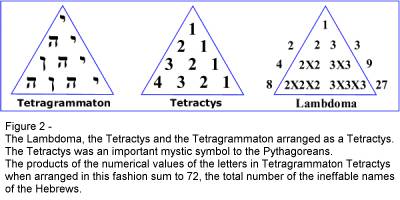
Here extends a link to the philosophy of Pythagoras and the Tetractys. Through the Pythagorean mystical tradition of mathematics the number 72 shows up as significant and related to the Divine Name.
The tradition extends to the 72 Names of God, derived from Exodus through complex permutation, each serving as a specific key to angelic forces and divine attributes within the Tree of Life. These names operate as formulae in ceremonial magic, where proper pronunciation and visualization can allegedly command elemental forces and restructure reality at its foundational level.
The paradox deepens in Hermeticism and Neoplatonism, where the ultimate divine principle - whether called Nous, The All, or The One - transcends language entirely. Here emerges the central tension: the most powerful “name” is precisely that which cannot be named. The Neoplatonic “One” exists beyond being, thought, or language, making any designation a mere convenience rather than a true appellation.
This nameless source generates the Logos, the first intelligible principle that bridges the ineffable and the manifest, suggesting that divine names function as progressive veils or emanations rather than direct designations. The practice of using divine names thus becomes a form of sacred geometry in sound, each vibration a step in the ladder of henosis - the mystical return to unity with the unnamed source.