A digital garden is a public space for growing ideas rather than publishing finished ones. Where the blog is a stream - chronological, polished, receding into an archive - the garden is a landscape: notes are planted as seedlings, revisited, pruned, cross-linked, and allowed to mature at their own pace. The gardening metaphor sets the ethos: imperfection is a stage of growth stage, and the visitor is invited to wander rather than scroll. The form traces to Mark Bernstein’s “Hypertext Gardens” and was revived by writers like Maggie Appleton, but its real lineage is older - the commonplace book, the Zettelkasten, the notebook kept in public.
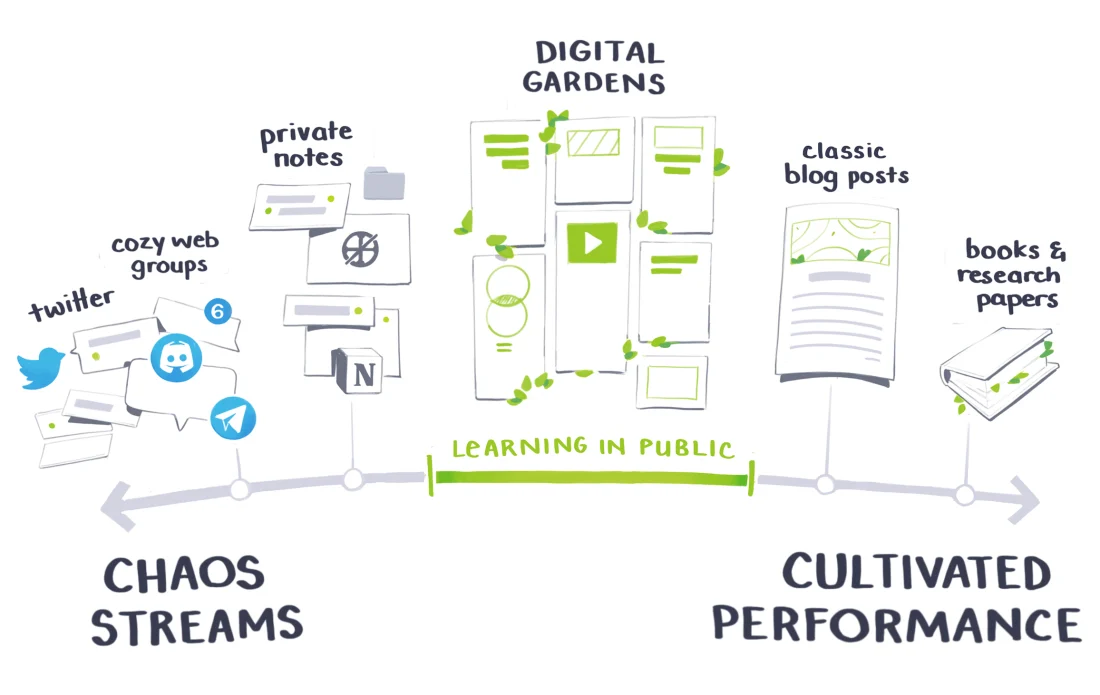
The practice reframes the Creative Process around learning in the open. Sharing thinking before it is finished converts the private accumulation of notes into an act of participation - readers encounter ideas mid-growth, and the gardener’s own understanding sharpens through the exposure. This is Distributed Cognition applied to writing: the garden becomes an external organ of memory and thought, and its web of links lets connections surface through emergence rather than planned structure - the through-lines reveal themselves in the tending.
Gardening also answers the perfectionism that stalls creativity. A garden is never done, so there is no finished state. The discipline shifts from crafting artifacts to sustaining a practice - regular watering over grand design - which makes it a natural container for action when the shape of the work keeps evolving faster than any fixed format can hold. In this sites own terms, the garden is where the acorn gets its soil, water, and sunshine: a place where calling is cultivated through small repeated acts rather than declared once.
See also creativity, Creative Process, action, Distributed Cognition, emergence, participation